(+27) 012 346 7858

insights
What is a Balanced Scorecard?
introduction
The Balanced Scorecard is a strategic performance management tool developed in the early 1990s by Dr Robert S. Kaplan and Dr David P. Norton.
The Balanced Scorecard is a comprehensive framework that enables businesses to align, prioritise, track, and measure their performance across different perspectives, including financial, customer, internal processes, and organisational capacity. By using the Balanced Scorecard, organisations can align their strategic and operational objectives and the relevant scorecards with their vision and mission and communicate them effectively to stakeholders.
"The concept of the Balanced Scorecard was born out of the realisation that financial measures alone were insufficient to provide a complete picture of a company's performance."
While financial performance is undoubtedly important, it does not tell the whole story. A company's long-term success depends on its ability to meet the needs of its customers, improve its internal processes, and develop the capacity to improve and innovate continuously. The Balanced Scorecard consists of four perspectives, which provide a value driver through the perspectives balancing the leading and lagging business narrative of how the organisation will deliver results.
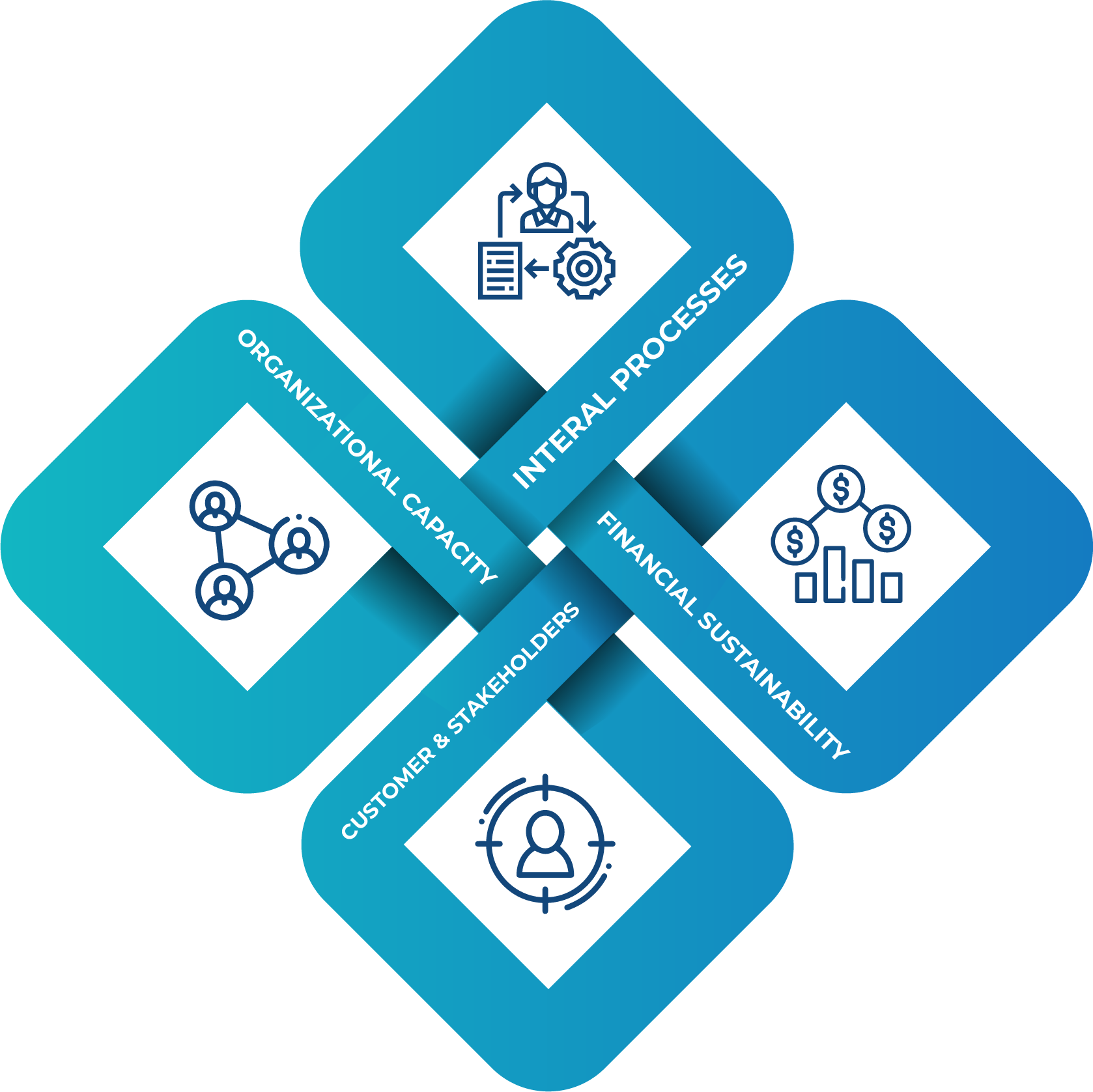
the balanced scorecard
The four perspectives
The financial perspective
The financial perspective (lagging) is concerned with the financial results that the organisation achieves, such as revenue growth, profitability, and return on investment.
The customer perspective
The customer perspective (lagging) focuses on tracking the results of the customer value proposition, including factors like functionality, economics, quality, image, and relationship.
The internal perspective
The internal perspective (leading) looks at the organisation's internal processes and systems and seeks to improve them for quality and efficiency.
the organizational capacity perspective
The Organisational capacity perspective (leading) is concerned with the organisation's ability to develop the capacity to deliver its strategy through improvement in its employees, technology, leadership, infrastructure, systems, and culture, to support continuous improvement and innovation.
Each perspective of the Balanced Scorecard includes a set of key performance indicators (KPIs) that measure progress and provide feedback on the organisation’s performance. For example, a financial KPI might be revenue growth or profit margins, while a customer KPI could be customer satisfaction or market share. An internal KPI might be cycle time or defect rates, and a learning and growth KPI might be employee engagement or skills development.
The Balanced Scorecard framework also emphasises the importance of aligning the organisation’s objectives, initiatives, and resources with its strategic objectives. It provides a structured approach to planning and implementation, where each perspective of the Scorecard is used to identify specific initiatives and action plans that support the organisation’s strategic objectives.
One of the key benefits of the Balanced Scorecard is that it provides a clear and comprehensive management system to deliver the organisation’s outcomes. As a management system, the Balanced Scorecard helps organisations identify potential issues and proactively take corrective actions. Creating a balanced business narrative by aligning strategy, operations, and initiatives informs a balanced measurement approach.
The Balanced Scorecard can also help to align the contribution of different teams and functions within the organisation by providing a disciplined framework and language for discussing performance. It can promote a culture of continuous improvement and innovation by encouraging employees to focus on the leading activities that drive results and outcomes.
However, implementing a Balanced Scorecard can be a complex and challenging process, especially for larger organisations. It requires a significant investment of time and resources to develop and refine the scorecard management system and collect and analyse the data required to measure performance accurately. It also requires strong leadership and commitment to ensure that the Scorecard Management is used effectively and that the necessary changes are made to improve performance.
conclusion
In conclusion, the Balanced Scorecard is a valuable management tool for strategic performance management that can help organisations to align their objectives, initiatives, and resources with their vision and mission.
Providing a balanced and comprehensive performance narrative across the four perspectives can help identify areas for improvement, align the efforts of different teams and functions, and promote a culture of continuous improvement and innovation. While implementing a Balanced Scorecard can be challenging, the potential benefits are significant and can help organisations achieve long-term results.
How we can help youLearn more


Our Balanced Scorecard Consulting services include:
• Balanced Scorecard assessment
• Balanced Scorecard development from scratch
• Recalibration of strategy into a Balanced Scorecards
• strategic management system
• Cascading and alignment of the strategy into the organisation
• Balanced Scorecard system maturity
With our experienced team, knowledge, experience, and guidance, you can rest assured that your organisation will be focused and aligned with the most effective strategy for creating positive sector impact and achieving lasting success.
Schedule a call with one of our experienced advisors and get the expert advice you need to improve your balanced scorecard management system.
Schedule a Call TodaySpeak to an advisor